
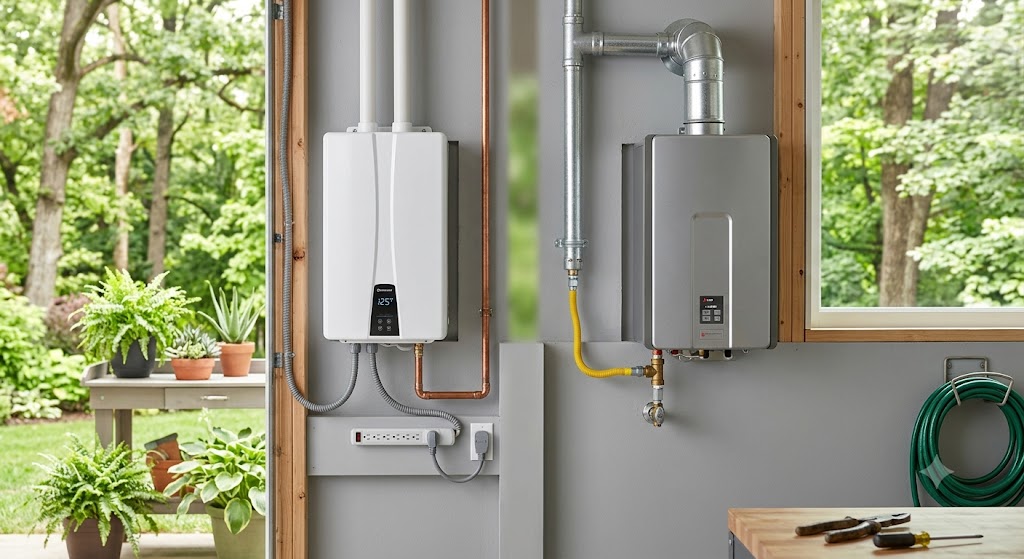
A homeowner in my area gutted his kitchen last year and had to choose between running a new gas line to a tankless unit or simply wiring in an electric model since the panel was already being upgraded anyway. He went electric, and his reasoning was refreshingly simple: no permit for gas line work, no venting to plan around, done in a weekend once the electrician finished. That tradeoff, simplicity versus raw capacity, is really what this decision comes down to.
Electric tankless water heaters like the Rheem RTEX-24 avoid the need for gas lines and venting entirely, making them simpler to install in homes without existing gas infrastructure, while gas tankless units typically offer higher flow rates and lower operating costs in regions with cheap natural gas, at the cost of requiring proper venting and gas line sizing. The right choice depends on what infrastructure your home already has and how much flow rate your household actually needs.
Side-by-Side: Core Differences
| Factor | Electric Tankless | Gas Tankless |
|---|---|---|
| Installation requirement | 240V electrical circuit(s) | Gas line plus venting |
| Typical flow rate | Up to 5.9 GPM (RTEX-24) | Often 8+ GPM for comparable units |
| Efficiency | No standby loss, self-modulating | Up to 96% efficiency (per Rheem’s published gas tankless specs) |
| Upfront unit cost | Generally lower ($549 for RTEX-24) | Generally higher for comparable capacity |
| Operating cost | Depends on local electricity rates | Depends on local natural gas rates |
| Venting required | No | Yes |
| Best suited for | Homes without gas infrastructure, smaller households | Larger households, homes with existing gas lines |
Why Choose Electric
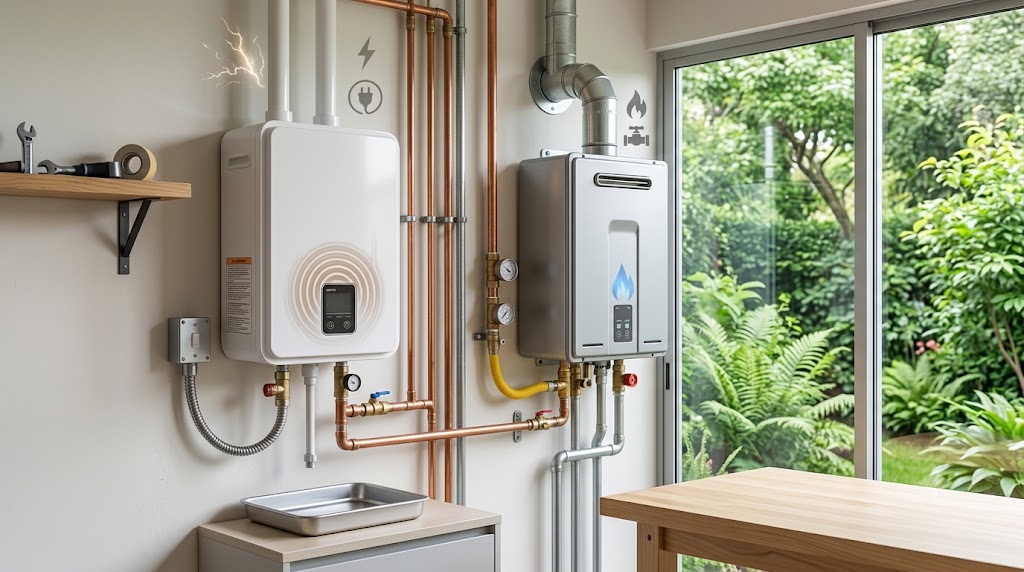
Electric tankless units skip two of the more complicated parts of a gas installation entirely: running or verifying gas line capacity, and installing proper venting to safely exhaust combustion byproducts. For a home like the RTEX-24’s target market, smaller to mid-sized households without existing gas infrastructure, that simplicity translates into a more predictable installation, even though the electrical work itself (three 40-amp double-pole breakers, 200-amp service recommended) is still a real, often professionally-required job.
Electric units also avoid any combustion-related safety considerations entirely, since there’s no flame or gas involved. For homes where adding a gas line isn’t practical or affordable, electric tankless is often the only realistic tankless option at all.
Why Choose Gas
Gas tankless units generally deliver higher flow rates for comparable unit sizes, which matters more for larger households running multiple bathrooms simultaneously. Rheem’s own gas tankless lineup reaches up to 96% efficiency according to company specifications, and in regions where natural gas is significantly cheaper per BTU than electricity, operating costs can be lower over time despite a higher upfront unit price.
If your home already has gas line infrastructure and proper venting is straightforward to install, gas tankless removes electric tankless’s core limitation: needing three or more dedicated high-amperage circuits and enough panel capacity to support them.
The Efficiency Question
Both categories are more efficient than traditional tank water heaters simply because tankless systems avoid standby heat loss, the energy wasted keeping a full tank of water hot around the clock even when nobody’s using it. According to Rheem’s own citation of Department of Energy figures, whole-home tankless models (electric, in this specific citation) can save up to 34% on water heating costs compared to tank systems.
The efficiency comparison between electric and gas specifically comes down to your local utility rates more than the technology itself. There’s no universal answer to “which is cheaper to run,” it depends entirely on what you pay per kWh of electricity versus per therm of natural gas in your specific area.
The Real Decision Factor: What You Already Have
For most homeowners, the deciding factor isn’t efficiency or flow rate, it’s what infrastructure already exists in the home. If you have gas line access and adequate venting options, gas tankless is worth serious consideration, especially for larger households. If you don’t have gas infrastructure and don’t want to add it, electric tankless units like the RTEX-24 solve the same core problem (running out of hot water) without that additional project.
For a full breakdown of what electrical work an electric tankless unit specifically requires, see our electrical requirements guide.
Rheem RTEX-24 24kW 240V Electric Tankless Water Heater - Check Current Price on Amazon
The Bottom Line
Electric tankless water heaters like the RTEX-24 skip gas line and venting requirements entirely, making them the simpler choice for homes without existing gas infrastructure. Gas tankless units generally offer higher flow rates for larger households, provided you’re willing to handle gas line and venting installation. Choose based on what your home already has and how much flow rate your household genuinely needs.
Frequently Asked Questions
Is electric or gas tankless water heater better? Neither is universally better. Electric is simpler to install without existing gas infrastructure, while gas typically offers higher flow rates for larger households. The right choice depends on your home’s existing setup and hot water demand.
Do electric tankless water heaters need venting? No. Electric tankless units like the Rheem RTEX-24 use electric resistance heating and produce no combustion byproducts, so venting is not required.
Are gas tankless water heaters more efficient than electric? Efficiency depends on the specific units being compared and local utility rates. Rheem’s gas tankless lineup reaches up to 96% efficiency per company specifications, while electric units avoid standby loss through self-modulating power draw.
Which is cheaper to install, electric or gas tankless? It depends on your home’s existing infrastructure. If you already have adequate electrical capacity, electric can be cheaper to install. If you already have gas line access and venting options, gas can be cheaper.
Can I switch from a gas tank water heater to an electric tankless unit? Yes, but you’ll need to have adequate electrical capacity added if it doesn’t already exist, which typically requires a licensed electrician and potentially a panel upgrade.
Do gas tankless water heaters have higher flow rates than electric? Generally yes, for comparable unit sizes, gas tankless units often achieve higher flow rates than electric models, making them a common choice for larger households.
Is the Rheem RTEX-24 electric or gas? The RTEX-24 is an electric tankless water heater, requiring 240V power and three 40-amp double-pole breaker circuits rather than a gas line.
Which type is safer, electric or gas tankless? Both are safe when properly installed by qualified professionals. Electric units avoid combustion-related considerations entirely, while gas units require proper venting to safely exhaust combustion byproducts.
Does my home need special wiring for an electric tankless water heater? Yes. Whole-home electric tankless units like the RTEX-24 require multiple dedicated double-pole breaker circuits and typically 200-amp household electrical service.
Should I choose gas or electric tankless for a large family? Larger households running multiple bathrooms simultaneously often benefit from gas tankless units’ higher flow rates, though a correctly sized electric unit or multiple electric units can also serve larger homes effectively.
References
- Rheem RTEX-24 official specifications, Amazon.com, accessed July 2026: https://www.amazon.com/dp/B01MS9DVEE
- Rheem citation of U.S. Department of Energy tankless water heater savings figures, via Amazon manufacturer content, accessed July 2026
- Rheem gas tankless water heater efficiency specifications, company product documentation, accessed July 2026