
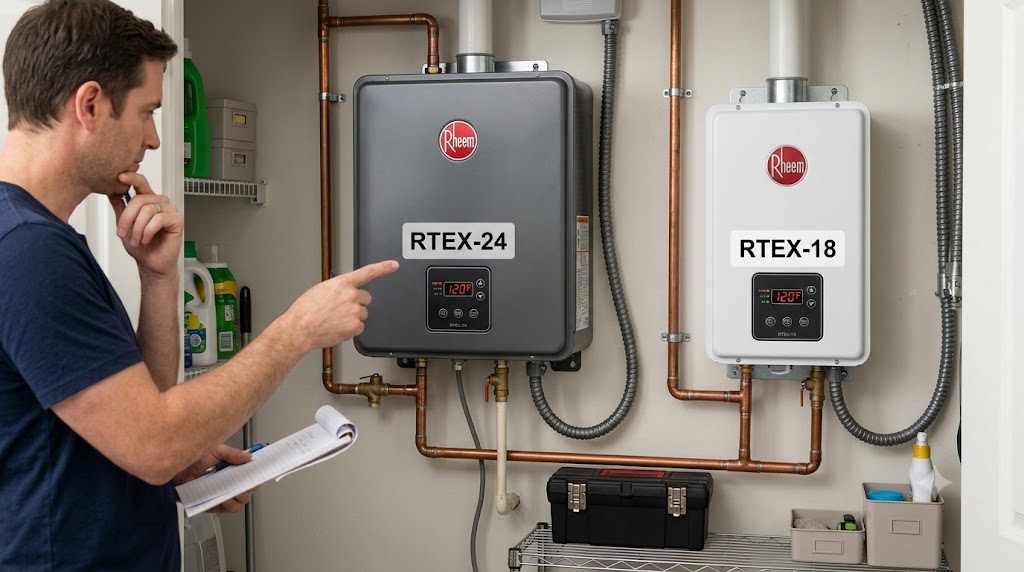
A homeowner in my local plumbing forum posted last year that she’d bought the RTEX-18 to save $111, then spent three times that on an electrician visit two months later swapping it out for the RTEX-24 because two teenagers showering back to back kept tripping cold water. Sizing mistakes on tankless heaters are expensive precisely because the fix means redoing electrical work, not just returning a box.
The Rheem RTEX-24 (24kW, up to 5.9 GPM) and RTEX-18 (18kW, up to 4.4 GPM) are both whole-home electric tankless water heaters, but the RTEX-24 delivers roughly 34% more flow capacity and can comfortably run 2 showers plus 2 sinks simultaneously, while the RTEX-18 is built for 2 showers alone. The RTEX-24 costs $549 versus $438 for the RTEX-18, a $111 difference for meaningfully more simultaneous hot water capacity.
Side-by-Side Comparison
| Spec | RTEX-18 | RTEX-24 |
|---|---|---|
| Power | 18 kW | 24 kW |
| Max flow rate | Up to 4.4 GPM | Up to 5.9 GPM |
| Fixtures served (max) | 2 showers | 2 showers, 2 sinks |
| Breakers required | 2 x 40 AMP | 3 x 40 AMP |
| Height | 18-1/4” | 18-1/4” |
| Width | 14-1/2” | 17-5/8” |
| Ship weight | 14.78 lbs | 17.8 lbs |
| Price (2026) | $438.00 | $549.00 |
Both units share the same height and water connection size (3/4” NPT), and both use Rheem’s self-modulating element design. The core difference comes down to one additional heating element and one additional 40-amp breaker circuit, which together buy you roughly 1.5 more GPM of usable flow.
When the RTEX-18 Is Genuinely Enough
If your household runs one shower at a time, occasionally alongside a sink or dishwasher, the RTEX-18’s 4.4 GPM ceiling is plenty. It’s also the better choice if your electrical panel is already tight on capacity, since it needs only two 40-amp double-pole circuits instead of three, which can be the difference between a straightforward install and needing a sub-panel.
Smaller households (1 to 2 people, single bathroom) rarely need more than the RTEX-18 provides, and paying $111 more for capacity you won’t use doesn’t make financial sense.
When You Need the RTEX-24 Instead
The math changes once you have multiple bathrooms actively used at the same time, a larger household, or a colder climate where incoming groundwater temperature is naturally lower. Remember that flow rate drops as the required temperature rise increases, so a unit rated for 4.4 GPM in a warm climate might only deliver 3 GPM or less somewhere with cold winters. That gap matters more when you’re already running close to the RTEX-18’s ceiling.
Rheem’s own family comparison chart shows the RTEX-24 rated for “2 Showers, 2 Sinks” simultaneously versus the RTEX-18’s “2 Showers” alone. If your household regularly has someone running a sink or starting laundry while two people shower, that extra sink capacity on the RTEX-24 is the practical difference between comfortable hot water and someone getting a cold surprise.
The Real Cost of Undersizing
Undersizing isn’t just an inconvenience, it can mean redoing your electrical work entirely. The RTEX-18 needs 2 double-pole 40-amp breakers, while the RTEX-24 needs 3. If you install the RTEX-18 to save money and later decide you need the RTEX-24, you’re not just swapping units, you’re potentially adding an entirely new breaker circuit and rerunning wire, which can cost more than the price difference between the two units in the first place based on real reviewer-reported electrician costs of $500 to $900 for this kind of work.
This is the exact reason it’s worth sizing generously upfront if your budget allows it and your panel has room. The $111 gap between the RTEX-18 and RTEX-24 is small compared to the cost of a second electrician visit down the line.
A Simple Way to Decide
Ask yourself these three questions:
- How many bathrooms will realistically run hot water fixtures at the same time, not in theory, but on a typical busy morning?
- What’s your regional groundwater temperature, since colder climates need more capacity to hit the same usable flow rate?
- Does your electrical panel currently have room for 2 or 3 double-pole 40-amp circuits, and if not, what would it cost to add that capacity now versus later?
If the answers point to occasional single-shower use in a moderate climate, the RTEX-18 is a smart, slightly cheaper choice. If there’s any regular overlap between multiple fixtures, or you’re in a colder region, the RTEX-24’s extra headroom is worth the modest price difference.
For the full technical rundown on the RTEX-24 specifically, see our complete specs breakdown.
Rheem RTEX-24 24kW 240V Electric Tankless Water Heater - Check Current Price on Amazon
The Bottom Line
The RTEX-18 and RTEX-24 share the same core design, but the RTEX-24’s extra element and breaker circuit buy real, usable flow capacity for households running multiple fixtures at once. If in doubt, size up. The cost difference between the units is small compared to the cost of redoing electrical work later.
Frequently Asked Questions
What’s the difference between the RTEX-18 and RTEX-24? The RTEX-24 has 24kW of power and up to 5.9 GPM flow versus the RTEX-18’s 18kW and 4.4 GPM. The RTEX-24 can run 2 showers plus 2 sinks simultaneously, while the RTEX-18 is rated for 2 showers alone.
Is the RTEX-24 worth the extra $111 over the RTEX-18? For households with overlapping hot water demand across multiple fixtures, or in colder climates, yes. For single-shower households in warm climates, the RTEX-18 is usually sufficient and cheaper.
How many breakers does the RTEX-18 need compared to the RTEX-24? The RTEX-18 needs 2 double-pole 40-amp breakers, while the RTEX-24 needs 3.
Can I upgrade from an RTEX-18 to an RTEX-24 later? Yes, but it typically requires adding a third double-pole breaker circuit, which means additional electrician work beyond simply swapping the unit itself.
Which model is better for a large family? The RTEX-24, given its higher simultaneous fixture capacity, is generally the better fit for larger households with overlapping hot water demand.
Does climate affect which model I should choose? Yes. Colder climates require more power to achieve the same temperature rise, which reduces effective flow rate. Homes in cold regions often need to size up compared to what a warm-climate household would choose.
Are the RTEX-18 and RTEX-24 the same physical size? They share the same height (18.25 inches), but the RTEX-24 is wider (17.625 inches vs 14.5 inches) and heavier (17.8 lbs vs 14.78 lbs) to accommodate the third heating element.
Do both models use the same water connections? Yes, both use 3/4 inch NPT fittings.
Is it cheaper to size up now or upgrade later? Sizing up now is almost always cheaper, since upgrading later often means adding new breaker circuits and possibly a sub-panel, which costs more in electrician labor than the price difference between the two units.
What if I’m not sure which size I need? Count how many fixtures in your home would realistically run hot water at the same time during a busy morning, and check your climate’s groundwater temperature. When in doubt, sizing toward the RTEX-24 provides a comfortable buffer.
References
- Rheem official RTEX family specifications and comparison chart, via Amazon.com manufacturer content, accessed July 2026: https://www.amazon.com/dp/B01MS9DVEE
- Verified Amazon customer reviews describing real-world electrical installation costs and experiences, accessed July 2026