
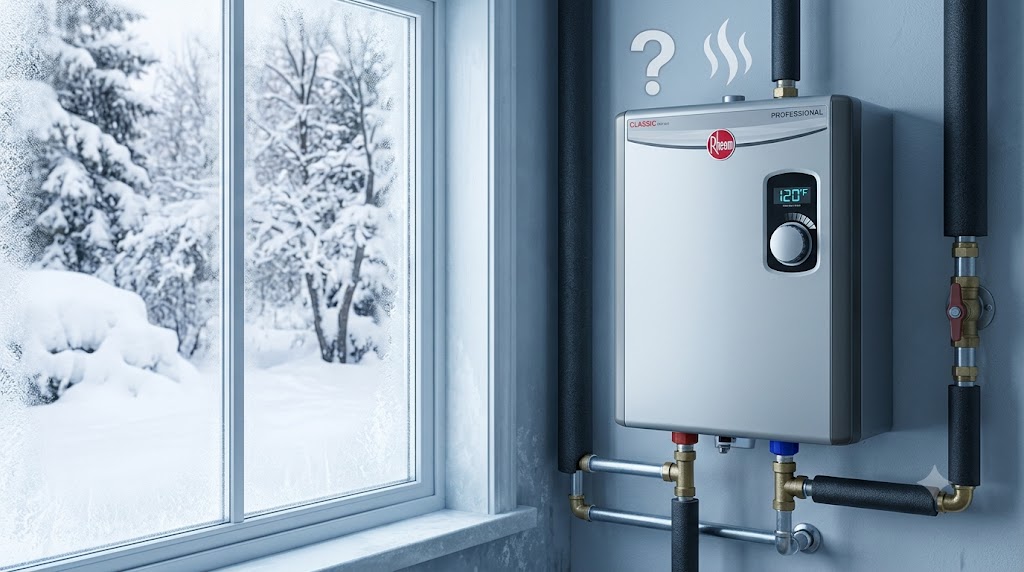
One verified RTEX-24 reviewer put it about as plainly as possible: they live in North Central Florida where groundwater sits at “a rock-solid 72F year-round,” calling it “the ideal setup for tankless electrics,” and specifically warned that buyers further north should expect the unit to “likely fall short at the exact worst time,” meaning the dead of winter. That’s the most honest cold-climate assessment you’ll find, straight from someone who understands exactly why it matters.
The Rheem RTEX-24’s advertised flow rate of up to 5.9 GPM assumes a warm-climate groundwater temperature, and actual usable flow drops meaningfully in cold climates because the unit has a fixed power budget to raise water temperature. Homes in cold regions should expect noticeably less than 5.9 GPM in winter and should size their unit accordingly, often requiring a larger capacity than a warm-climate household with the same fixture count.
Why Cold Water Changes Everything
Electric tankless water heaters work by applying a fixed amount of electrical power to raise incoming water to your desired output temperature. The math is straightforward: the colder your incoming water, the bigger the temperature rise required, and the bigger that rise, the less flow rate the unit can support while still hitting your target temperature.
This is why Home Depot’s own listing for the RTEX-24 shows 4.68 GPM specifically “at a 45-degree temperature rise,” a more conservative, realistic figure than Rheem’s own warm-climate 5.9 GPM ceiling. If your groundwater comes in at 40degF and you want 120degF output, that’s an 80-degree rise, nearly double the 45-degree example, and your realistic flow rate drops accordingly.
What Cold Climate Owners Actually Report
Verified reviews reflect this pattern directly. One detailed reviewer in a colder climate, on well water at the end of their utility line, described extensive troubleshooting including flow restrictors, pressure regulators, and eventually switching to a smaller unit specifically because their household’s cold groundwater and lower available amperage made the larger unit’s demands difficult to satisfy consistently. Their experience, while more complex than most (compounded by being at the end of a power line with lower available voltage), illustrates a real pattern: cold climate installations require more careful tuning than warm climate ones.
Rheem’s Own Guidance
Rheem’s product listing explicitly instructs buyers to “review performance guide image to confirm this water heater will provide the hot water needed based on geographic location,” directly acknowledging that geography and groundwater temperature materially affect real-world performance. This isn’t a hidden caveat, it’s stated plainly in the product’s own description, making it one of the most important details to actually read before buying.
How to Plan for Cold Climate Use
If you live somewhere with genuinely cold winters, plan your sizing around your coldest expected groundwater temperature, not the manufacturer’s best-case warm-climate figure. This often means:
Sizing up to a larger unit than a warm-climate household with the same number of bathrooms would need, since you’ll lose usable GPM to the larger required temperature rise.
Reducing simultaneous fixture expectations during winter months specifically, understanding that running two showers plus a dishwasher at once may work fine in summer but strain the system in January.
Considering whether a slightly lower output temperature setting (while still comfortable) can help stretch available flow rate further during the coldest months, since a smaller temperature rise requirement directly increases usable GPM.
Is Electric Tankless a Bad Choice for Cold Climates Entirely?
Not necessarily, but it requires more careful planning than in warm climates. Many cold-climate homeowners successfully run electric tankless systems, often by sizing up meaningfully beyond what the spec sheet suggests for their fixture count, or by installing point-of-use units at key fixtures alongside a smaller whole-home unit to spread the load. The key is going in with realistic expectations rather than assuming the manufacturer’s warm-climate GPM figure applies universally.
For the full sizing methodology that accounts for climate alongside fixture count, see our complete sizing guide.
Rheem RTEX-24 24kW 240V Electric Tankless Water Heater - Check Current Price on Amazon
The Bottom Line
The Rheem RTEX-24 works in cold climates, but not at its advertised 5.9 GPM ceiling. Real-world flow rate drops meaningfully as incoming groundwater temperature drops, and cold-climate buyers should size their unit around their coldest expected conditions, not the manufacturer’s warm-climate best case.
Frequently Asked Questions
Does the Rheem RTEX-24 work in cold climates? Yes, but at reduced flow rate compared to its advertised 5.9 GPM warm-climate figure, since colder incoming water requires a larger temperature rise, which reduces the unit’s usable flow capacity.
How much does cold weather reduce the Rheem RTEX-24’s flow rate? The exact reduction depends on your specific groundwater temperature, but Home Depot’s own listing shows 4.68 GPM at a 45-degree temperature rise, notably below Rheem’s 5.9 GPM warm-climate ceiling.
Should I buy a bigger unit if I live in a cold climate? Yes, cold-climate buyers should generally size up compared to what a warm-climate household with the same fixture count would need, to compensate for reduced usable flow rate.
Why does groundwater temperature affect tankless water heater performance? Electric tankless units have a fixed power budget to heat water. Colder incoming water requires a bigger temperature rise to reach your desired output temperature, which reduces the flow rate the unit can support.
Does Rheem provide guidance on cold climate performance? Yes, Rheem’s product listing directly instructs buyers to review a performance guide based on geographic location to confirm the unit will meet their needs before purchasing.
Can I still run two showers at once in a cold climate with the RTEX-24? It’s less certain than in a warm climate. Cold groundwater reduces usable flow rate, so running two showers simultaneously in winter may strain the unit more than the same scenario in summer.
What can I do to improve performance in a cold climate? Consider sizing up to a larger unit, slightly lowering your target output temperature to increase usable flow, or splitting demand across multiple units serving different zones of your home.
Is well water in a cold climate a bigger challenge for tankless heaters? It can be, especially if combined with lower available water pressure or voltage, as described by at least one verified reviewer who needed additional tuning equipment to get consistent performance.
Do all electric tankless water heaters have this same cold climate limitation? Yes, this is a fundamental characteristic of electric tankless technology generally, not specific to Rheem, since all these units share the same fixed power budget limitation.
Is electric tankless a bad choice for northern climates overall? Not necessarily, but it requires more careful sizing and realistic expectations. Many cold-climate homeowners successfully use electric tankless systems by sizing generously and understanding the real-world flow rate tradeoffs.
References
- Rheem RTEX-24 official product specifications and geographic performance guidance, Amazon.com manufacturer content, accessed July 2026: https://www.amazon.com/dp/B01MS9DVEE
- Home Depot product listing showing flow rate at specified temperature rise for the Rheem RTEX-24, accessed July 2026
- Verified Amazon customer reviews describing real cold climate and well water performance experiences, accessed July 2026