
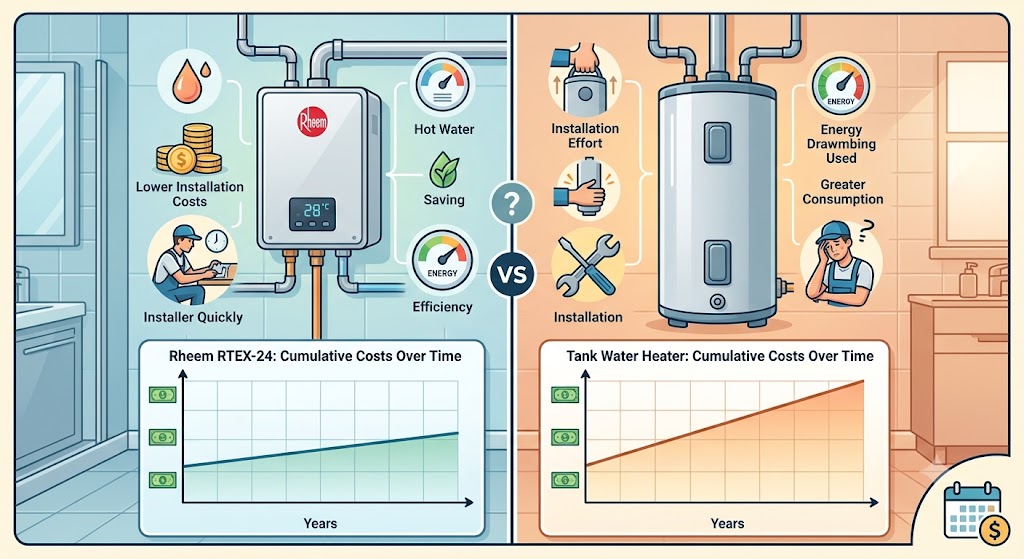
Dave, the neighbor I mentioned earlier who bought his RTEX-24 in a Sunday panic, told me the number that actually convinced him to stick with tankless long term wasn’t the sticker price, it was his utility bill six months later. That’s the honest way to evaluate this comparison: not just what you pay on day one, but what you pay every month after.
A Rheem RTEX-24 costs $549 upfront plus electrician installation (commonly $500 to $900 based on real reviewer-reported costs), compared to a typical 40-50 gallon tank water heater costing $400 to $900 installed, but tankless systems can save up to 34% on water heating costs long term according to Department of Energy figures cited by Rheem, since they eliminate standby heat loss. The higher relative installation cost for tankless is offset over time by lower operating costs, though the exact break-even point depends on your household’s hot water usage and local utility rates.
Upfront Cost Comparison
| Cost Factor | Rheem RTEX-24 (Tankless) | Typical Tank Water Heater |
|---|---|---|
| Unit price | $549.00 | $400-$900 (40-50 gallon electric) |
| Installation labor | $500-$900 (electrical work) | $150-$400 (simpler plumbing swap) |
| Electrical panel work | Often required | Rarely required |
| Total typical installed cost | $1,050-$1,450 | $550-$1,300 |
On pure upfront cost, a tank water heater is often cheaper to install, particularly if your existing electrical panel already supports the tankless unit’s requirements. The math shifts once you account for ongoing operating costs.
Ongoing Operating Cost: Where Tankless Pulls Ahead
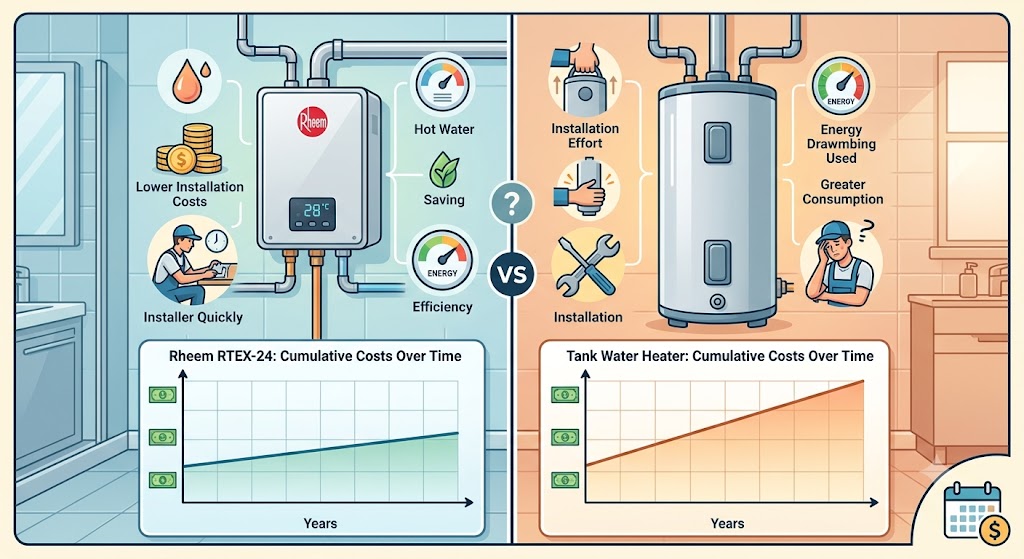
Traditional tank water heaters lose energy constantly through standby heat loss, the tank has to keep a large volume of water hot around the clock, even during the 20+ hours a day nobody’s using it. Tankless systems heat water only on demand, eliminating that waste entirely.
According to Department of Energy figures cited directly by Rheem in its own product marketing, whole-home tankless water heaters (like the RTEX-24) can save up to 34% on water heating costs compared to tank-type systems, while point-of-use tankless models can save up to 50%. Water heating typically accounts for a meaningful share of a household’s total energy bill, so a 34% reduction in that specific cost adds up over years of ownership.
One verified RTEX-24 reviewer provided real comparative data from their own utility bills: daily electric usage of 33.90 kWh in April 2025 compared to 31.34 kWh in April 2024 (the year before switching to tankless), describing the difference as “essentially a wash” since the household was taking longer showers simply because they could, no longer rationing hot water. That’s an honest, real-world data point: savings exist, but they can be offset by changed usage habits, which is worth knowing rather than assuming automatic savings regardless of behavior.
Lifespan Comparison
Tank water heaters typically last 8 to 12 years before needing replacement, according to general industry consensus, though this varies with water quality and maintenance. Tankless units, when properly maintained (particularly with periodic descaling in hard water areas), are generally expected to last longer, though exact lifespan varies by brand, usage, and water conditions. Real reviews for the RTEX-24 show a range of outcomes, some units running well past a decade, others experiencing component failures within the first year, often tied to water hardness or electrical setup issues rather than a fundamental design flaw.
Space and Convenience Factors
Beyond pure dollar cost, tankless units like the RTEX-24 free up real physical space, at just 3.5 inches deep and roughly 18 by 18 inches, compared to a traditional tank that can be 60+ inches tall and 20+ inches in diameter. Rheem markets this as up to 93% smaller than a standard electric tank water heater, which several verified reviewers specifically cite as a meaningful benefit, one mentioned converting the freed-up space into a small storage closet.
Tankless units also never run out of hot water mid-use, a benefit that shows up repeatedly across positive reviews, particularly in households with multiple people showering back to back.
Which One Actually Makes Financial Sense for You?
If you’re replacing a failing tank water heater and don’t already have adequate electrical capacity for a tankless unit, the upfront cost gap (potentially $500+ more for tankless once electrical work is factored in) is real and worth weighing against your household’s actual hot water usage patterns. Smaller households with modest usage may not recoup that gap quickly.
If your electrical panel already has room, or you’re doing other electrical work simultaneously anyway (like a kitchen renovation), the marginal cost of going tankless drops significantly, and the long-term savings plus space benefits make a stronger case.
For the complete rundown of what the RTEX-24 offers and where it falls short, see our full review.
Rheem RTEX-24 24kW 240V Electric Tankless Water Heater - Check Current Price on Amazon
The Bottom Line
Tankless systems like the Rheem RTEX-24 typically cost more upfront once installation is factored in, but can save up to 34% on ongoing water heating costs according to Department of Energy figures, plus free up real physical space. Whether that trade-off makes sense for you depends on your existing electrical setup and how much hot water your household actually uses.
Frequently Asked Questions
Is a tankless water heater cheaper than a tank water heater? Not usually upfront, once installation costs are included, tankless units like the RTEX-24 often cost more to install due to electrical requirements. Long term, tankless systems can save up to 34% on operating costs according to Department of Energy figures.
How much does it cost to switch from a tank to a tankless water heater? Expect to pay for the unit itself ($549 for the RTEX-24), plus electrician labor for electrical work, commonly $500 to $900 based on real reviewer-reported costs, and potentially a panel upgrade if your existing capacity is insufficient.
Do tankless water heaters really save money? Yes, primarily by eliminating standby heat loss. Department of Energy figures cited by Rheem show whole-home tankless models can save up to 34% on water heating costs compared to tank systems, though actual savings depend on usage habits.
How long does a tank water heater last compared to tankless? Tank water heaters typically last 8 to 12 years. Tankless units can last longer with proper maintenance, though real-world lifespan varies significantly based on water quality and installation quality.
Is it worth paying more upfront for a tankless water heater? For households with consistent hot water demand and adequate existing electrical capacity, the long-term savings and space benefits often justify the higher upfront cost. Smaller households with modest usage may see a longer payback period.
Does a tankless water heater increase my electric bill? It changes how you use electricity for water heating, but doesn’t necessarily increase your total bill, since it eliminates standby heat loss. Some users report usage staying flat because they take longer showers, offsetting some of the efficiency gain.
Can I install a tankless water heater in the same spot as my tank? Often yes for the plumbing connection, but the electrical requirements (three 40-amp double-pole breakers for the RTEX-24) are separate from the plumbing location and depend on your panel’s capacity and proximity.
Do tankless water heaters need more maintenance than tank heaters? Tankless units generally benefit from periodic descaling, especially in hard water areas, to prevent mineral buildup on heating elements. Tank heaters also require maintenance like periodic flushing, so the difference is more about the specific maintenance tasks than the overall frequency.
Is the Rheem RTEX-24 a good replacement for a 50 gallon tank? Yes, for small to mid-sized households with moderate hot water demand, multiple verified reviewers specifically report successfully replacing 50-gallon tanks with the RTEX-24.
What’s the biggest hidden cost of switching to tankless? Electrical work is the most commonly underestimated cost. Real reviewer-reported electrician costs for the RTEX-24 installation range from $500 to $900, sometimes more if a sub-panel is required.
References
- Rheem citation of U.S. Department of Energy water heating savings figures, via Amazon.com manufacturer content, accessed July 2026: https://www.amazon.com/dp/B01MS9DVEE
- Verified Amazon customer reviews providing real utility bill comparison data and installation cost figures, accessed July 2026