
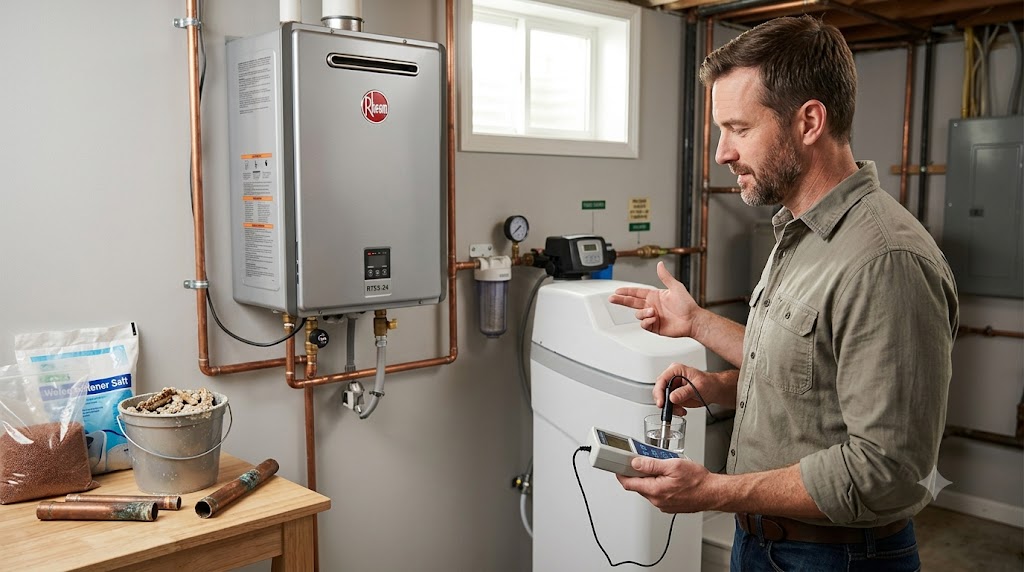
Multiple verified reviews of RTEX units point to the same underlying pattern behind premature heating element failure: hard water. One particularly candid reviewer stated it plainly, recommending that anyone buying this kind of unit “install a water softener or they probably won’t last long without regular maintenance descaling it.” That’s a strong endorsement worth taking seriously if you don’t already know your local water hardness.
A water softener isn’t strictly required to run a Rheem RTEX-24, but in hard water areas, it directly addresses the root cause of the mineral scale buildup that verified reviews repeatedly link to premature heating element failure, potentially reducing both maintenance frequency and long-term repair costs. Soft water areas generally see less benefit from adding a softener specifically for the tankless unit’s sake, though other household benefits of softened water may still apply.
How Hard Water Damages a Tankless Unit
Hard water contains dissolved calcium and magnesium, which precipitate out as solid mineral scale when heated, exactly what happens continuously inside a tankless water heater’s elements. Over time, this scale coats the heating elements, reducing their efficiency and increasing the risk of overheating and premature failure, a pattern documented across multiple verified RTEX reviews describing element failures within the first year of ownership.
A water softener uses an ion exchange process to remove these hardness-causing minerals from your water before it ever reaches your tankless unit, addressing the problem at its source rather than relying solely on periodic descaling to remove scale after it’s already formed.
Softener vs Regular Descaling: Which Do You Actually Need?
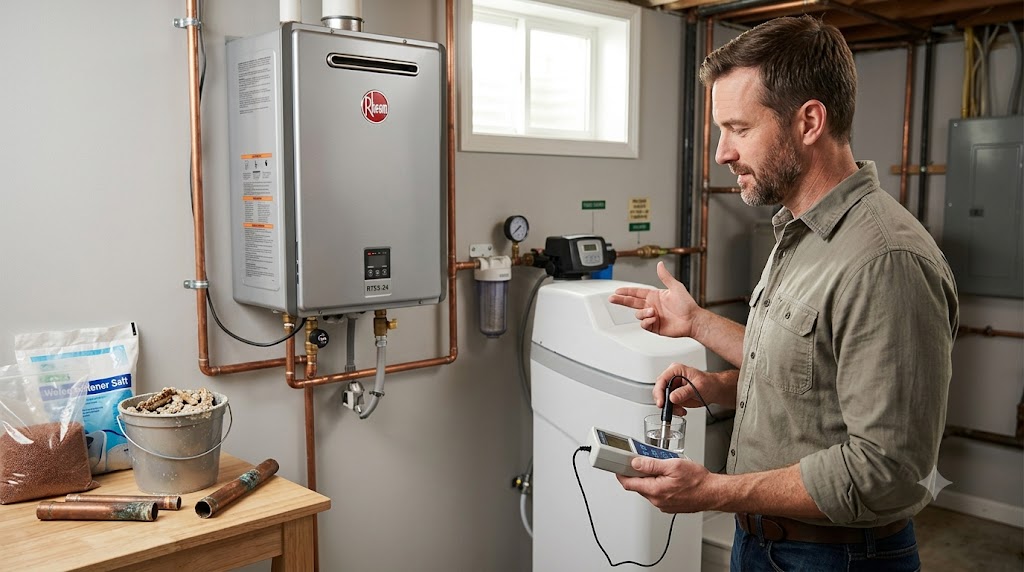
These two approaches aren’t mutually exclusive, and understanding the difference helps clarify what each one does. A water softener prevents scale from forming in the first place by removing the minerals before they reach your heating elements. Regular descaling removes scale that has already formed, essentially damage control after the fact.
In genuinely hard water areas, relying on descaling alone means your elements are still experiencing some degree of ongoing mineral exposure between maintenance cycles. A softener reduces that exposure continuously, which is why the verified reviewer quoted above specifically recommended it as a way to meaningfully extend the unit’s working life, not just as an alternative to descaling.
Do You Actually Have Hard Water?
Before investing in a water softener, confirm your actual water hardness. Many municipal water utilities publish hardness data for their service area, or you can use a simple home test kit to check directly if you’re on well water or unsure of your municipal supplier’s numbers. Water hardness is typically measured in grains per gallon (GPG), with higher numbers indicating harder water that benefits more from softening.
The Cost-Benefit Calculation
A water softener represents a real upfront investment, plus ongoing costs for the salt or other media it uses to regenerate. Weigh this against the documented pattern in verified reviews of premature element failure and the associated repair or replacement costs in genuinely hard water areas. For households already dealing with hard water’s other effects (soap scum, mineral spots on dishes, dry skin), a softener addresses multiple problems simultaneously, making the tankless water heater benefit one part of a broader value proposition rather than the sole justification.
For households with already soft or moderate water, the case for a softener specifically for tankless heater protection is weaker, and your descaling maintenance schedule alone may be sufficient.
Making the Decision
If you’re in a confirmed hard water area and want to maximize your RTEX-24’s lifespan while minimizing maintenance frequency, a water softener is a reasonable investment supported by real reviewer experience. If you’re in a soft to moderate water area, a consistent descaling schedule (covered in our maintenance guide) is likely sufficient on its own.
For the complete maintenance schedule regardless of whether you add a softener, see our full maintenance guide.
Rheem RTEX-24 24kW 240V Electric Tankless Water Heater - Check Current Price on Amazon
The Bottom Line
A water softener isn’t required to run a Rheem RTEX-24, but in hard water areas, it directly addresses the mineral buildup that verified reviews consistently link to premature heating element failure. Confirm your local water hardness first, then weigh the softener’s cost against your unit’s documented risk of early component failure in your specific conditions.
Frequently Asked Questions
Do I need a water softener for my Rheem RTEX-24? Not strictly required, but in hard water areas, a softener can meaningfully reduce mineral buildup on the heating elements, potentially extending the unit’s lifespan based on patterns in verified owner reviews.
How does hard water damage a tankless water heater? Dissolved minerals in hard water precipitate as scale when heated, coating the heating elements and reducing their efficiency while increasing the risk of premature failure.
Is a water softener better than regular descaling? They solve different problems. A softener prevents scale from forming by removing minerals before they reach the elements, while descaling removes scale that has already formed. Many hard water households benefit from using both.
How do I know if I have hard water? Many municipal water utilities publish hardness data for their service area, or you can use a simple home test kit if you’re on well water or unsure of your specific numbers.
Will a water softener eliminate the need for descaling entirely? Not entirely, but it can reduce how often descaling is needed by addressing the root cause of mineral buildup before it accumulates on the elements.
Is a water softener worth the cost just for my tankless water heater? If you’re in a confirmed hard water area, the potential to avoid premature element failure and reduced maintenance frequency can justify the investment, especially when combined with other household benefits of softened water.
Do I need a softener if I already have soft water? Generally no, if your water is already soft to moderate, a consistent descaling schedule is likely sufficient without needing to add a softener specifically for the tankless unit’s protection.
Can hard water void my Rheem RTEX-24 warranty? Check your specific warranty documentation, since damage attributable to inadequate maintenance in known hard water conditions may affect coverage in some cases.
What’s the difference between a water softener and a water filter? A softener addresses water hardness (dissolved minerals) through ion exchange, while a filter typically addresses physical sediment and particulate matter, solving different problems that can be used together.
How much does a water softener cost to run long term? Beyond the upfront unit cost, water softeners require ongoing supply costs (typically salt or another regenerating media), which should be factored into your overall cost-benefit calculation for protecting your tankless unit.
References
- Verified Amazon customer review recommending water softener use to extend tankless water heater lifespan, accessed July 2026: https://www.amazon.com/dp/B01MS9DVEE